Firearms Safety
Making it easier to meet licence obligations
Responsibilites
Service Design, Research, UX/UI
Organisations
NZ Police, Firearms Safety Authority

Contents
Background
Following the Christchurch mosque attacks in March 2019, the New Zealand Government committed to fundamentally reforming the country's firearms laws. Te Tari Pūreke – Firearms Safety Authority was established in 2022 as a new dedicated regulator, replacing Police as administrator of the Arms Act.
Following the launch of New Zealand's Firearms Registry, Te Tari Pūreke needed to improve, grow and redesign end-to-end services for 228,000+ licence holders – spanning discovery, design and delivery across both internal staff-facing and external user-facing services. I joined as the lead contract Service Designer on a large transformation programme.
My role
Lead contract Service Designer, accountable for the overall design approach – from research strategy through to service blueprinting, UX/UI design and design system. I led and mentored a wider design team throughout.
A note on confidentiality
Some artefacts from this project have been blurred or are not shown publicly due to some service changes still in development. The work shown here has been selected to represent the approach and outcomes without compromising privacy or confidentiality.
Discovery
Driving people-centred decisions through discovery
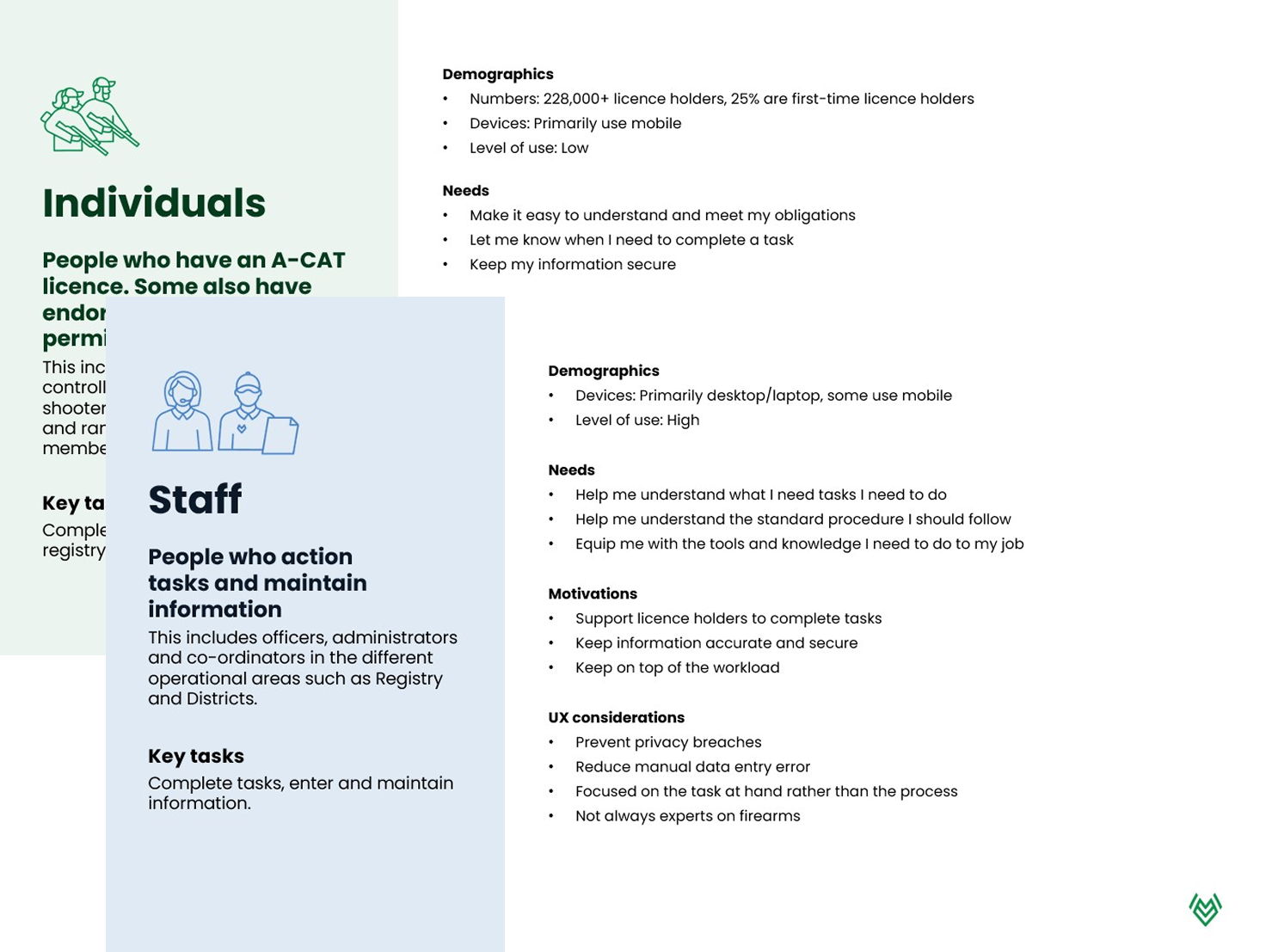
I established the design foundations for the programme – defining design principles, project outcomes and audience definitions that gave the team a shared lens for every decision. The three key audiences had very different needs and levels of digital literacy:
Individuals – 228,000+ licence holders, 25% of whom were first-time holders, primarily using mobile devices, with a low level of digital engagement
Dealers – businesses managing complex transaction, stock and staff access workflows with high task frequency
Staff – Te Tari Pūreke officers, administrators and coordinators completing regulatory tasks and maintaining the integrity of the registry
Understanding these differences was critical – a service that worked for a tech-confident dealer would not work for a rural licence holder registering firearms for the first time.
Leading nationwide research and stakeholder engagement
I pitched for, planned and led nationwide research across New Zealand – including in-person and online sessions with licence holders, dealers and internal staff. I synthesised findings into clear discovery artefacts and presented insights to internal teams, senior leaders, ministers and licence holder community forums – ensuring research reached the people with the power to act on it.
Key insights shaped the programme's direction: dealers already had their own custom software systems and needed the registry to integrate with familiar workflows rather than replace them; security and privacy were non-negotiable concerns across all audiences; and trust in the new system needed to be built carefully, particularly with a community that had experienced significant regulatory change in a short period of time.

Design
Mapping the holistic experience to inform opportunities
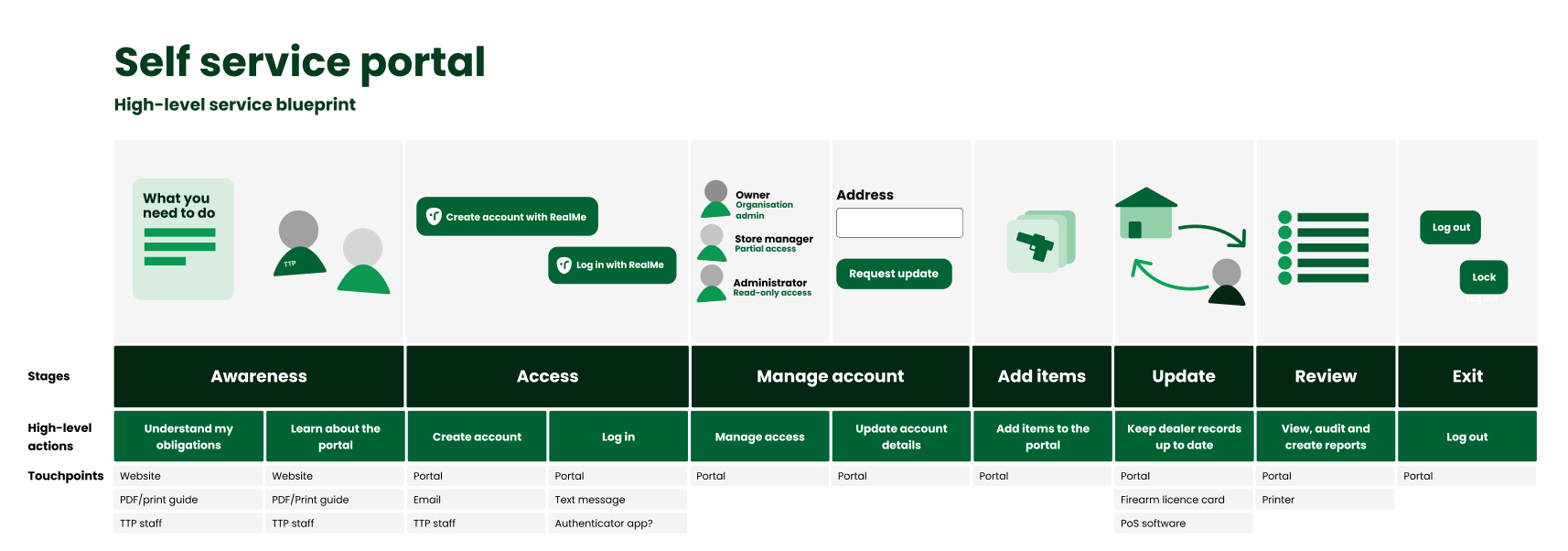
I used service blueprinting, journey mapping and prototyping to make the complex simple – identifying opportunities across the end-to-end experience that informed leadership decisions, internal process improvements and design priorities for technology enhancements.

Setting the foundations for transformation
I led UX/UI design for the dealer self-service portal – a complex product with multiple user types, permission levels and transaction types. I created low and mid-fidelity prototypes tested iteratively with users, and established a design system for the low-code software that improved delivery speed and product consistency across the programme.
Building team capability
I mentored junior designers and researchers throughout the programme – embedding research methods, design principles and collaborative ways of working that strengthened the team's ability to deliver people-centred design beyond my individual contribution.
Result
Efficient service delivery and an improved service for 228,000+ licence holders
Permit application processing efficiency improved by 30% due to addressing painpoints in guidance and form content
Design foundations established for a national transformation programme
Nationwide research delivered and presented to ministers and community forums – directly informing legislative and design decisions
Foundations for new technology changes designed for multiple user types and permission levels
Design system established for low-code software, improving delivery speed and product consistency
Junior designers mentored and Community of Practice strengthened